Introduction: The Macro Pulse of Global Currency Markets
Every single day, trillions of dollars flow across borders through electronic communication networks, central bank balance sheet adjustments, and corporate treasury operations. To the novice trader staring exclusively at moving averages, RSI indicators, and support lines, sudden and violent price spikes can seem entirely random. Currency pairs like EUR/USD, GBP/JPY, or USD/CAD can violently break tight consolidation ranges in a matter of milliseconds, shattering stop-loss orders and leaving bewildered accounts devastated. Why did this happen? The answer almost always rests on a single scheduled data print displayed on a global economic calendar.
Mastering foreign exchange trading requires an acute awareness that technical price action is merely the symptom, while fundamental macroeconomics is the underlying engine. Central banks do not set interest rates based on geometric chart patterns; they adjust monetary policy based on hard economic reality—inflation metrics, employment numbers, and gross domestic product growth. This comprehensive guide will teach you how to read, interpret, and trade around economic calendar events with institutional discipline, ensuring you never get caught on the wrong side of a major macro news release.
1. Demystifying the Economic Calendar: Structure and Significance
An economic calendar is a live schedule of macroeconomic data releases, central bank speeches, policy meetings, and treasury auctions from across the globe. Major economies—including the United States, the Eurozone, the United Kingdom, Japan, Canada, Australia, and New Zealand—release statistical reports on fixed schedules. These schedules are known months in advance, giving market participants time to position capital or hedge existing risk exposures.
These announcements possess the highest potential to cause massive volatility and immediate spread widening across major, minor, and exotic currency pairs. Examples include the U.S. Non-Farm Payrolls (NFP), Consumer Price Index (CPI) inflation reports, and Federal Reserve Rate Decisions. Institutional desks reallocate billions of dollars within seconds of these releases.
While important for tracking localized economic health (such as regional retail sales or housing starts), these data points rarely trigger systemic market shocks on their own unless they deviate wildly from consensus forecasts. They serve as secondary puzzle pieces for macroeconomic analysts mapping multi-month trends.
Understanding how to filter out low-noise events and focus entirely on high-impact catalysts is the first step toward professional macro awareness. If you ignore the calendar, you are essentially blindfolded while driving a high-speed vehicle through institutional liquidity zones.
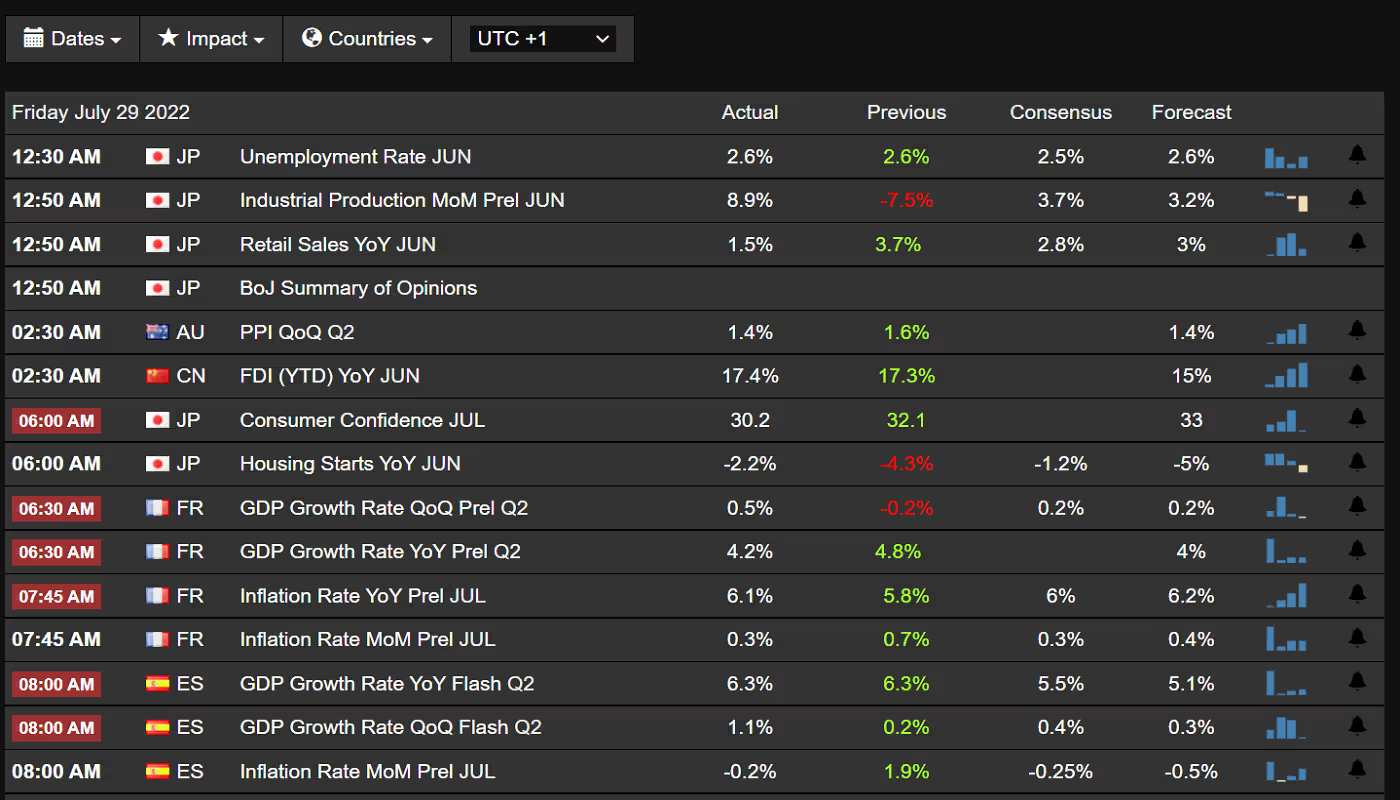
Reference Blueprint: Anatomy of an Economic Calendar Feed
fxone.online research labBelow is a structural breakdown of how professional trading terminals display high-impact indicators prior to execution. Notice how impact levels and consensus values are arranged side-by-side.
Visualizing High-Impact News Volatility & Slippage
Watch this institutional masterclass breaking down how order books react during major CPI and central bank interest rate announcements.
2. The Big Three: Inflation, Employment, and Growth Metrics
Not all economic indicators carry equal weight in the foreign exchange market. Central banks maintain explicit mandates focused primarily on price stability (controlling inflation) and maximum sustainable employment. Consequently, traders focus heavily on three core macroeconomic categories:
1. Inflation Reports (CPI, PPI, PCE)
The Consumer Price Index (CPI) and Personal Consumption Expenditures (PCE) price index measure changes in the cost of a basket of consumer goods and services. High inflation forces central banks to raise interest rates aggressively to cool economic demand, which historically strengthens that nation's currency. Conversely, cooling inflation hints at imminent rate cuts, putting downward pressure on the currency's valuation.
2. Employment Data (Non-Farm Payrolls & Unemployment Rate)
Released on the first Friday of every month, the U.S. Non-Farm Payrolls (NFP) report details the net change in civilian employment outside the agricultural sector. Robust job creation signals a thriving economy capable of sustaining higher interest rates, whereas a weak reading triggers immediate safe-haven flows or dollar depreciation. Similar weight is given to the UK Claimant Count and Eurozone unemployment figures.
3. Gross Domestic Product (GDP) and Retail Sales
GDP represents the total monetary value of all finished goods and services produced within a country over a specific quarter. It serves as the ultimate report card for economic health. Retail sales data provides an early glimpse into consumer spending habits, which drive over two-thirds of economic activity in advanced nations like the United States.
3. Reading the Matrix: Actual, Forecast, and Previous Values
When you view an economic calendar event, you will notice three primary numerical columns: Previous, Forecast, and Actual. Amateurs often make the fatal mistake of assuming that a "good" economic number means the currency will automatically rally. Markets do not trade on absolute numbers; they trade on expectations and surprises.
The revised statistical result from the prior reporting period (e.g., last month's or last quarter's finalized data). It sets the baseline historical comparison.
The median prediction compiled from major institutional economists and Wall Street analysts ahead of the release. Asset prices usually price in this expectation beforehand.
The official government or institutional print released in real-time. The deviation between Actual and Forecast drives instantaneous market volatility.
The Golden Rule of News Trading:
If the forecast for U.S. inflation is 3.2% and the actual print comes out at 3.5%, the currency will react violently upward because inflation exceeded expectations, suggesting tighter monetary policy ahead—even though 3.5% inflation is technically an "undesirable" macroeconomic condition for consumers.
Economic Indicator Impact Matrix
Examine how specific macroeconomic data releases impact major currency pairs and dictate institutional capital flows.
| Economic Indicator | Frequency | Primary Impacted Pairs | Market Reaction to Beat (Higher than Forecast) |
|---|---|---|---|
| Non-Farm Payrolls (NFP) | Monthly | EUR/USD, USD/JPY, GBP/USD | USD Bullish (Dollar rallies, gold and majors drop) |
| Consumer Price Index (CPI) | Monthly | All USD, EUR, and GBP Pairs | Currency Bullish due to anticipated rate hike pressures |
| Central Bank Rate Decisions | Every 6 Weeks | Pairs tied to respective central bank | Immediate aggressive trend expansion or reversal |
| Gross Domestic Product (GDP) | Quarterly | AUD/USD, USD/CAD, NZD/USD | Economic strength validation supporting national currency |
4. Strategic Approaches: How Retail and Pro Traders Handle News
Trading directly during high-impact news releases is notoriously difficult due to extreme volatility, wide retail spreads, and execution slippage. Professional traders generally adopt one of three distinct approaches when managing economic calendar events:
Closing all open positions and canceling pending stop orders 30 minutes prior to a red-folder event. This protects capital from erratic spread widening and liquidity gaps.
Waiting for the initial emotional spike to exhaust itself, letting algorithms trap aggressive breakout retail traders, and then trading in the direction of the true higher-timeframe trend.
Advanced quantitative execution involving pending buy-stop and sell-stop orders placed outside pre-news consolidation ranges, capturing the eventual breakout direction.
During our early years backtesting live desk operations at fxone.online, our research desk attempted to scalp an incoming U.S. Non-Farm Payrolls print on the EUR/USD pair with a tight 10-pip stop loss. When the headline beat consensus by over 100,000 jobs, the resulting institutional liquidity vacuum caused our broker spread to instantly widen from 0.8 pips to 14.5 pips. Our position did not trigger at our target stop level; instead, it suffered severe slippage, executing 22 pips past our intended risk threshold. That painful lesson permanently taught us why professional traders either stay flat during high-impact releases or trade with drastically reduced position sizing.
5. Common Pitfalls When Reading Economic Calendars
Even with a clean economic calendar open on your desktop, beginners frequently fall into psychological and technical traps that compromise their trading performance. Avoid these common mistakes:
-
Ignoring Local Timezones: Misinterpreting UTC or GMT release times, leading you to enter trades minutes before a catastrophic market shockwave without realizing it.
-
Trading Without Stop-Losses During News: Leaving unhedged positions open during NFP or CPI releases. Extreme liquidity vacuums can execute your stop far beyond your specified price point.
-
Chasing Initial Spikes: Buying the top of a green candle right after a positive news print, only to watch institutional algorithmic desks sweep liquidity and reverse price instantly.
Summary: Aligning With Macro Realities
The economic calendar is your window into the macro heartbeat of global currency markets. By understanding how inflation, employment, and central bank policies dictate long-term capital flows, you elevate your trading from blind technical guessing to institutional-grade analysis. Always check the calendar before every trading session, respect high-impact red folder events, and protect your capital through rigorous risk management.
About the Author: FX Research Team, fxone.online
The FX Research Team at fxone.online comprises institutional market analysts, macroeconomic forecasters, and veteran currency traders dedicated to elevating educational standards in retail foreign exchange. Our curriculum cuts through noise, focusing entirely on fundamental catalysts, risk metrics, and structural price mechanics.