Introduction: Why Doing Nothing is the Hardest and Most Profitable Skill in Forex
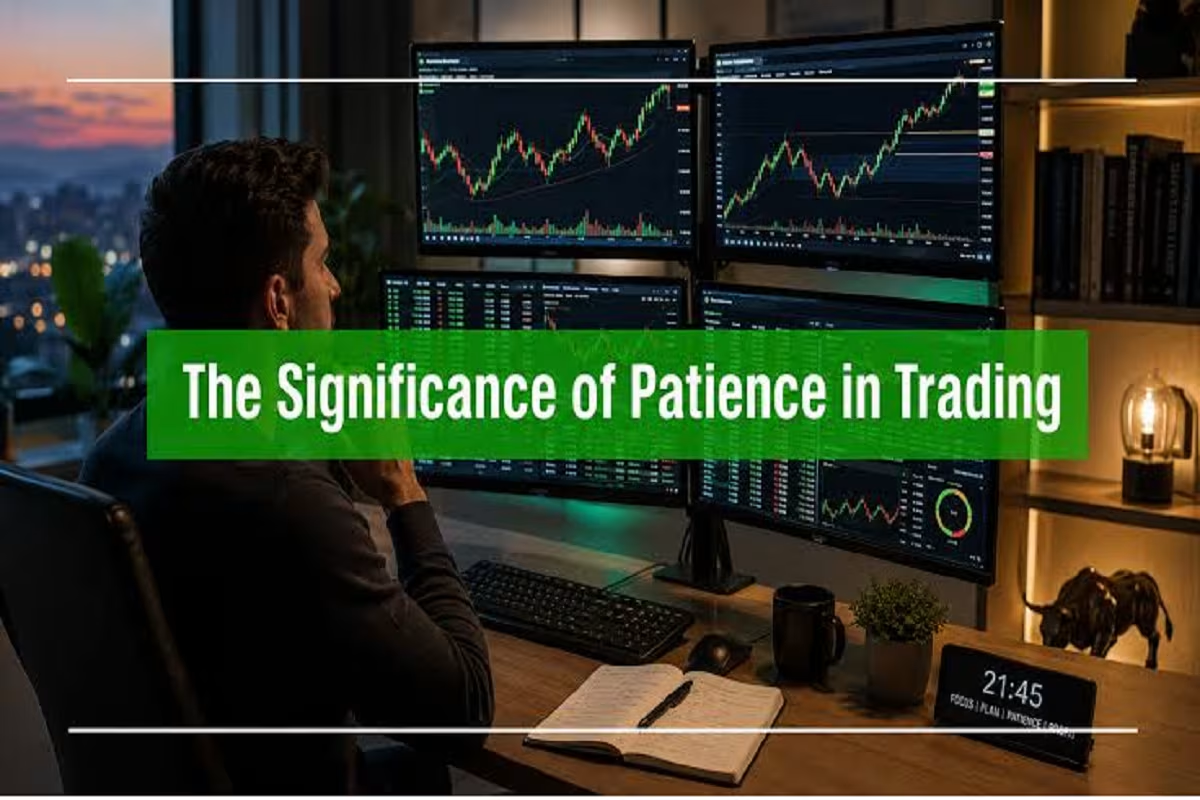
In the high-stakes environment of global foreign exchange trading, retail participants are conditioned by modern consumer culture to believe that constant activity equates to productivity. We live in a world of instant gratification, fast-paced digital stimulation, and rapid transactions. When applied to currency markets, this relentless urge to "do something" becomes the primary catalyst for account destruction. Amateurs sit in front of multi-monitor setups for hours, staring at erratic five-minute price fluctuations, feeling an overwhelming compulsion to click buy or sell simply because the market is open. They treat foreign exchange like a video game or a casino slot machine, confusing motion with tangible progress.
In stark contrast, institutional portfolio managers, hedge fund directors, and elite proprietary traders spend up to 90% of their operational hours doing absolutely nothing. They sit on their hands, review macro data filters, update risk parameters, and wait in absolute stillness for price to arrive at pre-defined institutional zones. To an elite trader, sitting on the sidelines is not a passive or boring state; it is an active risk-management decision. This comprehensive masterclass blueprint explores the deep psychological mechanisms of patience, the neurological triggers of overtrading, and the structured operational frameworks required to transform yourself from an impulsive retail gambler into a disciplined, sniper-like institutional executioner.
1. The Psychological Trap: Decoding Boredom, Dopamine, and Overtrading
To master patience, you must first understand the biological and psychological forces that compel traders to force suboptimal setups. Human beings are wired to seek immediate rewards. When you place a live trade—regardless of whether it has a statistical edge—your brain releases a rush of dopamine. If the trade wins, you experience euphoria; if it loses, your brain triggers a stress response that often leads to a frantic desire to recover losses through revenge trading.
Treating trading as entertainment creates an unhealthy psychological addiction to volatility. Traders enter positions out of sheer boredom during quiet consolidation ranges, completely ignoring macroeconomic context.
Retail minds feel intense anxiety when watching a currency pair trend without them. This fear of missing out (FOMO) forces premature market entries into overextended moves right before a sharp reversal.
Professionals operate like elite snipers in a hide site. They wait days for the exact environmental variables to align before pulling the trigger, knowing that missed opportunities carry zero financial cost.
Forcing low-quality trades degrades your profit factor. By eliminating substandard executions, you protect your capital base and allow your high-probability edge to compound uninterrupted over time.
Recognizing these internal behavioral triggers is the first vital step toward building impenetrable trading discipline. When you view inaction as your primary protective shield, patience becomes second nature.
Behavioral Matrix: Impulsive Retail Gambler vs. Patient Institutional Sniper
fxone.online research labThe comparative breakdown below illustrates the psychological and operational differences between emotional overtrading and structured patience.
2. Defining High-Probability Setups: What Are You Actually Waiting For?
Patience cannot exist in a vacuum. You cannot simply decide to be patient while staring at a blank chart without knowing what you are waiting for. True patience is born from crystal-clear operational definitions. If you do not have a rigorous, objective checklist that defines an A+ trade setup, every single price fluctuation will look like an opportunity, leading directly to chronic overtrading.
Institutional traders wait exclusively for confluences where multiple structural variables intersect. Follow this four-part checklist to identify genuine high-probability currency setups:
-
Higher-Timeframe Directional Bias: Map daily and 4-hour market structures (Higher Highs and Higher Lows for bullish trends; Lower Lows and Lower Highs for bearish trends). Never trade against the macro tide.
-
Institutional Liquidity Sweep: Wait for price to aggressively sweep obvious retail stop-loss pools at previous swing highs or lows, signaling that smart money has absorbed public liquidity.
-
Order Block or Fair Value Gap (FVG) Retracement: Identify structural imbalance zones left behind by institutional expansion candles, and wait for price to return to these exact magnet levels.
-
Favorable Risk-to-Reward Ratio: Ensure the execution structure allows for a minimum 1:3 risk-to-reward ratio with a tight, logically placed stop-loss behind market structure.
When these four institutional criteria align simultaneously, your execution goes from speculative guessing to high-probability mathematical execution.
Visual Masterclass: Mastering Patience and Spotting High-Probability Setups
Watch this intensive analytical breakdown examining how professional currency traders cultivate mental discipline, filter out market noise, and wait patiently for institutional confluence zones.
3. Operational Systems: Practical Rules to Force Discipline and Eliminate Boredom
Expecting willpower alone to keep you disciplined in front of live moving charts is a recipe for failure. Willpower is a finite psychological resource that depletes rapidly under stress. Instead of relying on raw willpower, elite traders construct robust environmental and operational guardrails that make overtrading physically difficult.
Implement these four operational protocols in your daily routine to enforce strict patience:
-
Use Price Alerts and Close Your Charts: Set precise price alerts at your higher-timeframe order blocks and close your trading platform. Only open your charts when an alert triggers, eliminating screen fatigue and impulsive micro-management.
-
Enforce Session Time Windows: Restrict your trading activity to specific high-liquidity windows (such as the London open or New York morning session). If no setup appears within your designated window, shut down your terminal for the day.
-
Implement a Daily Trade Maximum Rule: Cap your maximum execution limit at one or two trades per day. Knowing you only get one bullet per session naturally forces you to wait for the highest-quality setup available.
-
Shift Focus to Backtesting and Journaling: During quiet market consolidation periods, channel your active energy into backtesting historical price data, reviewing past journal entries, or studying macro fundamentals.
Structuring your trading day with strict operational boundaries protects your capital from emotional interference and transforms waiting into a disciplined, productive habit.
Comparative Matrix: Reactive Overtrader vs. Disciplined Institutional Sniper
Review the clear operational distinctions in daily routine, risk control, and execution patience between reactive retail traders and institutional snipers.
| Behavioral Metric | Reactive Overtrader Approach | Disciplined Institutional Sniper Protocol | Long-Term Impact on Account |
|---|---|---|---|
| Screen Time Management | Glued to 1-minute and 5-minute charts for 8 hours daily | Sets automated price alerts and reviews charts twice daily | Prevents emotional fatigue and impulse entries |
| Setup Selectivity | Takes every minor market wiggle that resembles a pattern | Waits for multi-timeframe confluence and liquidity sweeps | Maximizes win rate and expectancy ratios |
| Reaction to Missed Moves | Chases runaway price action with high-risk FOMO market orders | Maintains absolute emotional equilibrium and looks for next cycle | Preserves capital and avoids unnecessary drawdowns |
During an institutional mentorship audit conducted by the fxone.online research team, we evaluated currency trader David, who had suffered continuous account drawdowns over a six-month period. David's trading journal revealed a staggering average of 14 executions per day on EUR/USD and GBP/USD across five-minute charts. When interviewed, David admitted he felt intense anxiety whenever he was not in a trade, constantly fearing he would miss a major market move. This emotional compulsion led him to force trades during low-volatility Asian consolidation ranges, resulting in frequent stop-loss hits and accumulating commission costs. Our analytical team intervened by enforcing strict operational rules: David was mandated to delete all lower-timeframe charts from his primary workspace, restrict his trading window exclusively to the first two hours of the London session, and implement a strict maximum limit of one trade per day backed by a mandatory checklist. Furthermore, we instructed him to log every single hour spent waiting on the sidelines as productive "sniper watch time." Initially, David experienced severe psychological discomfort and boredom during his waiting periods. However, within three weeks, the results were transformative. By filtering out erratic noise and waiting exclusively for 4-hour order block confluences, David's trade frequency dropped from 70 trades a week to just 6 high-conviction executions. His profit factor surged from 0.8 to 2.9, and his account achieved steady institutional profitability. This case study demonstrates conclusively that in foreign exchange trading, less activity combined with absolute patience yields superior financial returns.
4. Summary Mastery: Cultivating Patience as Your Ultimate Trading Edge
Mastering patience in foreign exchange trading is not about suppressing your emotions through sheer willpower; it is about building a systematic operational framework that makes patience your natural state of operation. When you understand that the foreign exchange market operates 24 hours a day, five days a week, you realize there will always be another high-probability setup tomorrow. Missing a move today carries zero financial penalty, whereas forcing a bad trade guarantees financial loss.
-
Embrace Inaction as Profit Protection: Treat sitting on the sidelines as an active, intelligent management decision that safeguards your capital from unnecessary market noise.
-
Trust Your Institutional Checklist: Let objective structural confluences—not emotional impulses—dictate when you enter the market.
-
Prioritize Quality Over Quantity: Remember that elite currency traders measure success not by how many trades they take, but by the precision and discipline of their executions.
Cultivating sniper-like patience is the ultimate dividing line between struggling retail speculators who donate capital to brokers and elite institutional professionals who build lasting wealth in the global currency markets.
Frequently Asked Questions
How can I stop myself from trading out of boredom?
Combat boredom by closing your charts, setting automated price alerts at major higher-timeframe order blocks, restricting trading to specific session windows, and channeling your extra energy into backtesting and journaling.
What is the ideal number of trades to take per week?
Professional institutional traders typically execute between 2 to 5 high-conviction setups per week. Focusing strictly on quality over quantity prevents overtrading and significantly improves your overall profit factor.
Summary: Securing Long-Term Consistency Through Sniper Patience
Developing patience to wait for high-probability setups is the crowning achievement of trading mastery. By replacing emotional impulses with structured operational rules, setting automated price alerts, and treating inaction as a vital risk-management tool, you eliminate the destructive cycle of overtrading. True currency trading success belongs entirely to those disciplined enough to wait in silence for the perfect moment to execute.
About the Author: FX Research Team, fxone.online
The FX Research Team at fxone.online comprises institutional market analysts, macroeconomic forecasters, and veteran currency traders dedicated to elevating educational standards in retail foreign exchange. Our curriculum cuts through noise, focusing entirely on fundamental catalysts, risk metrics, and structural price mechanics.