Introduction: Navigating the Velocity of Macroeconomic Releases
Few phenomena in the global financial markets match the raw, explosive energy of a major macroeconomic data release. When the United States Bureau of Labor Statistics releases the monthly Non-Farm Payrolls (NFP) report, or when the Consumer Price Index (CPI) inflation figures hit institutional Bloomberg and Reuters terminals at 8:30 AM Eastern Time, the foreign exchange market undergoes a violent and immediate transformation. Spreads widen instantly, liquidity thins out across electronic communication networks (ECNs), and currency pairs can surge or plummet by hundreds of pips within seconds.
For novice retail traders, high-impact news events represent a hazardous casino floor characterized by random slippage, rejected orders, and catastrophic account drawdowns. However, for professional institutional desks, macro hedge funds, and systematic algorithmic traders, these exact moments represent periods of supreme clarity. By understanding how institutional order books absorb macroeconomic surprises, how algorithms scan headline deviations against median consensus forecasts, and how price discovery transitions from panic to stability, traders can transform high-impact news from a dangerous hazard into a structured, highly repeatable execution framework. This comprehensive masterclass deconstructs the structural mechanics, pricing models, and risk protocols required to navigate CPI, NFP, and GDP announcements with professional discipline.
1. The Big Three: Decoding CPI, NFP, and GDP
While dozens of economic indicators cross the wires every week, only a select few possess the structural weight required to shift global central bank policy expectations and alter multi-quarter currency trends. These core indicators are universally monitored across all major financial capitals.
The Consumer Price Index measures the average change over time in the prices paid by urban consumers for a market basket of consumer goods and services. It dictates central bank interest rate trajectories more than any other metric.
Non-Farm Payrolls track the number of paid US workers excluding farm employees, government workers, and non-profit staff. It serves as the primary health barometer for the world's largest economy and dictates USD valuation.
Gross Domestic Product represents the total monetary value of all finished goods and services produced within a country. Though lagging in nature, quarterly GDP revisions validate or shatter prevailing macroeconomic narratives.
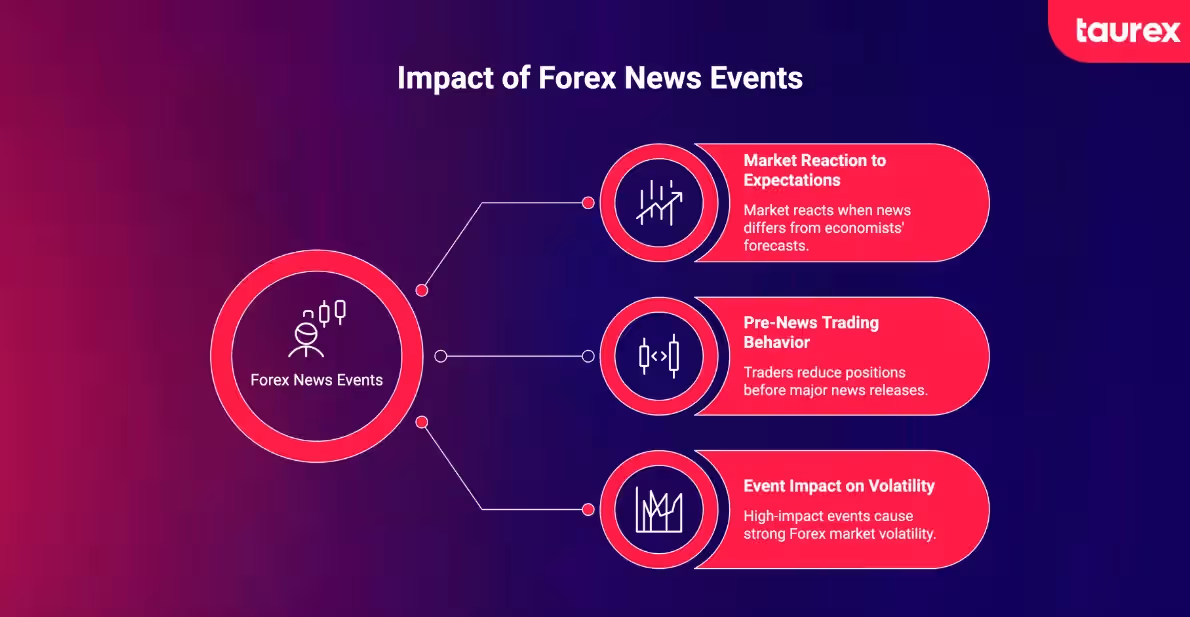
Comprehending how institutional investors weigh actual releases against prior revisions and median economist surveys provides the essential baseline for anticipating market reactions before the data is even published.
Desk Terminal Matrix: Economic Release Impact Hierarchy
fxone.online research labThe simulation below outlines institutional volatility scoring and typical currency responses across major tier-1 macroeconomic data points.
2. High-Frequency Trading and Algorithmic Price Discovery
To trade news successfully, one must understand who sits on the other side of the order book during a data release. Modern financial markets are dominated by High-Frequency Trading (HFT) proprietary firms and algorithmic market makers. These computers do not interpret economic reports subjectively; they parse raw numeric strings within microseconds.
-
The Deviation Metric: Algorithms instantly compare the printed headline number against the consensus median forecast gathered from Bloomberg or Reuters polls. The magnitude of the price surge is directly proportional to the standard deviation from expectations.
-
The Initial Whip: The first wave of price movement is often a liquidity trap. Algorithms sweep resting retail stop-loss orders positioned just above or below key technical barriers, creating false breakouts before true institutional direction takes hold.
-
Liquidity Withdrawal: Tier-1 liquidity providers frequently widen spreads or pull quotes entirely milliseconds before a major release to protect themselves against toxic order flow, causing severe slippage for unmanaged retail market orders.
Recognizing that the initial 60 seconds following a major news release are governed by algorithmic hunting patterns prevents traders from executing blind market orders during maximum volatility windows.
Visual Masterclass: Decoding News Release Order Flow and Liquidity Sweeps
Watch this comprehensive analytical breakdown illustrating how institutional desks monitor economic data prints and navigate algorithmic whipsaws during NFP releases.
3. Strategic Execution Methodologies: Pre-News vs. Post-News
Professional traders generally approach high-impact news releases using one of two structured methodologies. Trying to predict the exact number beforehand is pure speculation; managing reaction frameworks is professional execution.
Here is how institutional desks evaluate the two primary news trading strategies:
-
Method 1: The Post-Release Retracement (The fxone.online Preferred Approach): Instead of trading the initial chaotic spike, wait for the dust to settle. Let the market sweep initial liquidity, form a clear impulse leg, and retrace into an institutional order block or fair value gap. This filters out noise and provides clean risk-to-reward parameters.
-
Method 2: The Volatility Breakout (Straddle Setup): Placing pending stop-buy and stop-sell orders above and below a tight pre-news consolidation range. While effective during extreme deviations, this method is vulnerable to " whipsaw fills" where the market triggers both orders due to immediate two-way volatility.
Mastering patient observation allows traders to capitalize on institutional participation that enters the market 15 to 30 minutes after the initial headline shock.
Comparative Matrix: News Trading Approaches & Risk Profiles
Evaluate the operational mechanics, advantages, and hazards of different news trading tactics used across global markets.
| Execution Style | Timing Window | Primary Advantage | Primary Risk / Hazard |
|---|---|---|---|
| Post-Release Retracement | 15 to 60 minutes post-release | High win-rate, clean structure, reduced slippage | Missing moves that trend cleanly without pulling back |
| Pre-News Straddle (Pending Orders) | Seconds before release | Captures explosive directional moves instantly | Severe slippage, wide spreads, dual-fill whipsaws |
| Naked Speculation (Guessing) | Pre-release entry | None | Account wipeout via catastrophic margin call |
During a highly anticipated US Consumer Price Index release analyzed by the fxone.online research desk, headline inflation printed 0.4% higher than median consensus estimates. In the initial 10 seconds, EUR/USD plunged 80 pips, sweeping resting retail sell stops below daily support. Unprepared retail accounts rushed to sell the breakout at the exact low tick. Our institutional desk recognized the move as a classic liquidity sweep into a 4-hour order block. Rather than chasing the initial plunge, we waited for the 15-minute candle close. Once price rejected the lows with a strong bullish engulfing structure, we executed long positions with tight stops below the sweep wick, capturing a 140-pip corrective rally as macro funds rebalanced their portfolios.
4. Quantitative Risk Protocols for News Events
Trading high-impact macroeconomic data without strict mathematical guardrails is an invitation to account destruction. Because spreads can expand by 500% during major NFP releases, professional trading desks enforce four immutable risk rules:
-
Reduce Position Sizing by 50%: Cut standard risk parameters in half during major news days to account for inevitable execution slippage and erratic spread widening.
-
Widen Stop-Loss Buffers: Avoid placing stop-losses directly at obvious technical levels during news events, as algorithmic wick sweeps will target those exact zones.
-
Flat Pre-Release Management: Close or hedge existing intraday swing positions 15 minutes before Tier-1 releases to eliminate unmanaged gap risk.
-
Verify Broker Execution Quality: Ensure your brokerage environment provides stable ECN routing and deep liquidity pools capable of handling extreme news volatility without freezing.
Frequently Asked Questions
Why do currency prices often move in the opposite direction of the news?
Markets price in expectations long before an economic report is published. If strong employment numbers were already heavily anticipated ("priced in"), institutional desks often take profit on their positions immediately after the release, causing a counter-trend reversal known as "buying the rumor, selling the fact."
Is it safe to use market orders during CPI or NFP releases?
Using market orders during high-impact news events is extremely dangerous because of wide spreads and rapid price gaps, which frequently result in severe negative slippage. Professional traders rely on limit orders or wait for price stabilization before entering positions.
Summary: Mastering High-Impact News Events
Trading high-impact macroeconomic events like CPI, NFP, and GDP requires a profound respect for institutional mechanics and algorithmic behavior. By avoiding blind speculation, abandoning dangerous pre-news straddles, and waiting for post-release market structure confirmation, you can navigate volatility with confidence. Combine these tactical frameworks with rigorous risk management to protect your capital and extract consistent profits from global macroeconomic shifts.
About the Author: FX Research Team, fxone.online
The FX Research Team at fxone.online comprises institutional market analysts, macroeconomic forecasters, and veteran currency traders dedicated to elevating educational standards in retail foreign exchange. Our curriculum cuts through noise, focusing entirely on fundamental catalysts, risk metrics, and structural price mechanics.