Introduction: Capital Magnetism in Global Fixed Income Markets
In the architecture of international finance, capital does not sit stagnant; it flows ceaselessly across national borders in search of the highest risk-adjusted yield. While short-term retail speculators often obsess over minute technical patterns, institutional macro funds, sovereign wealth managers, and major commercial banks operate on a much larger gravitational force: interest rate differentials. The disparity between the benchmark interest rates of two sovereign central banks forms the structural foundation for some of the largest and most enduring trends in the foreign exchange market.
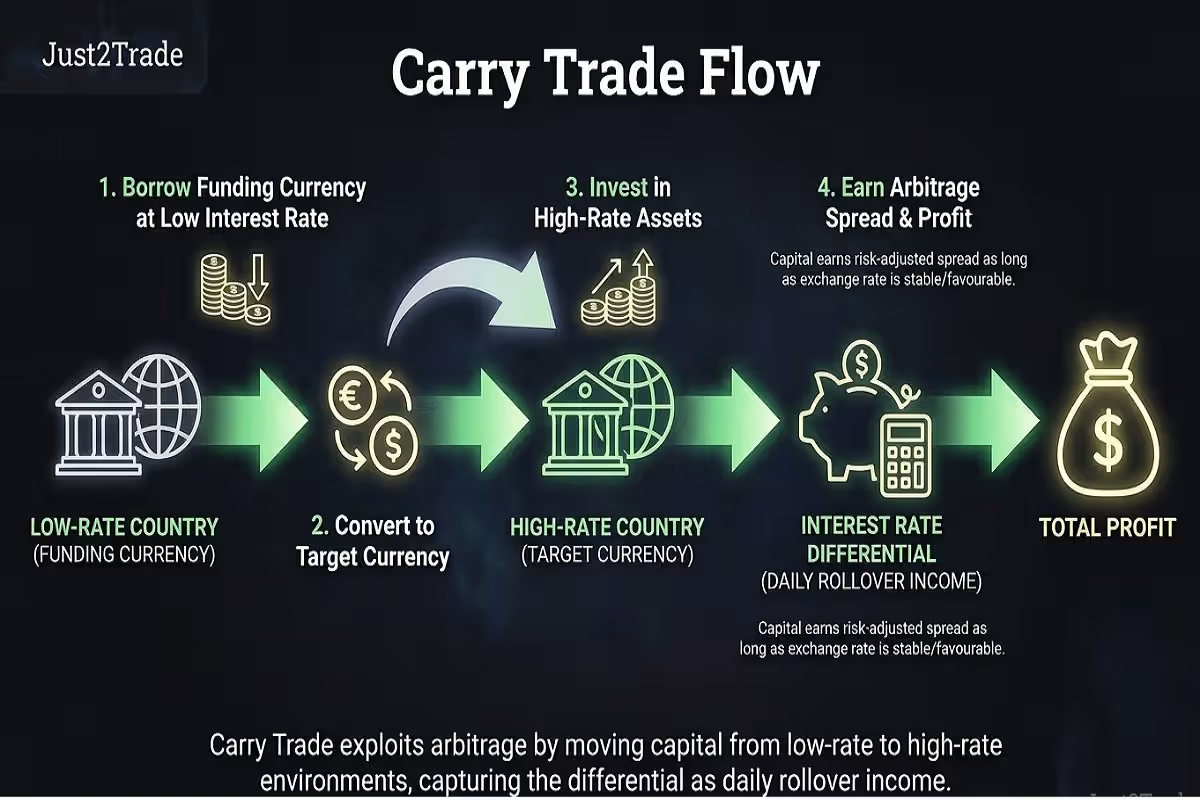
Among these macro-driven strategies, the foreign exchange carry trade stands out as one of the oldest and most widely deployed institutional techniques. By borrowing capital in a low-interest-rate currency and investing it in a high-yielding foreign debt instrument, global investors aim to capture both the regular interest rate spread (known as positive swap or carry) and potential capital appreciation. However, like any institutional strategy, the carry trade carries hidden structural vulnerabilities. When global risk sentiment shifts abruptly, unhedged carry trades can unwind with astonishing velocity, triggering massive liquidity cascades. This masterclass decodes the mathematics, execution frameworks, and risk profiles governing interest rate differentials and carry trade dynamics.
1. The Core Mechanics of Interest Rate Differentials
An interest rate differential represents the arithmetic difference between the benchmark monetary policy rates set by two separate central banks. For example, if the United States Federal Reserve maintains a benchmark interest rate of 5.25% while the Bank of Japan (BoJ) keeps its policy rate anchored near 0.10%, the interest rate differential between the USD and the JPY is approximately 5.15% (515 basis points).
Institutional investors managing multi-billion-dollar bond portfolios cannot afford to leave capital in zero-yielding or negative-yielding sovereign debt. A wide interest rate differential acts as a massive financial magnet, drawing foreign institutional capital into the higher-yielding currency's domestic bond and money markets.
Professional desks do not look at nominal rates alone. They calculate real interest rate differentials by subtracting domestic inflation rates from nominal benchmark rates. A country with high nominal rates but runaway inflation may actually offer negative real returns, deterring sophisticated long-term capital inflows.
Understanding how these rate gaps expand and contract over multi-quarter economic cycles allows swing traders to align their positions with the underlying macro tide rather than fighting institutional capital flows.
Desk Terminal Matrix: Interest Rate Spread & Currency Valuation Flow
fxone.online research labThe simulation below illustrates how institutional capital reallocates based on shifting central bank rate divergences.
2. Anatomy of the Carry Trade: Execution and Mechanics
The foreign exchange carry trade is a strategy whereby an investor borrows a low-yielding currency (the funding currency) and uses the proceeds to purchase assets denominated in a high-yielding currency (the target currency). Beyond potential capital gains or losses from exchange rate fluctuations, the trader collects the daily interest rate differential, credited or debited to retail and institutional accounts as swap interest.
-
The Funding Currency Selection: Historically, currencies with structurally low interest rates—such as the Japanese Yen (JPY) or Swiss Franc (CHF)—serve as ideal funding currencies. Investors effectively borrow cheaply because domestic monetary policy remains highly accommodative.
-
Target Yield Harvesting: The borrowed capital is converted into a high-yielding asset, such as Australian Dollars (AUD), New Zealand Dollars (NZD), or emerging market currencies featuring attractive sovereign bond yields.
-
The Daily Swap Accrual: For every day a position is held past rollover time (5:00 PM EST), the broker credits the positive interest rate differential to the trader's account, compounding returns over weeks and months.
While the daily swap earnings can be lucrative, carry trades are vulnerable to capital depreciation. If the high-yielding target currency drops in value by more than the annual interest collected, the net trade results in a loss.
Visual Masterclass: Deconstructing Carry Trade Flows and Risk Unwinding
Watch this comprehensive analytical breakdown illustrating how institutional desks monitor interest rate spreads and manage risk during global liquidity squeezes.
3. The Dark Side of Carry Trades: Sudden Unwinding and Risk-Off Shocks
The greatest hazard in carry trading is encapsulated by the financial market adage: *"The carry trade goes up the stairs and jumps out the window."* Because carry trades often rely on high leverage and crowded institutional positioning, they are exceptionally sensitive to shifts in global market sentiment.
When global equity markets crash, geopolitical tensions escalate, or unexpected macroeconomic shocks occur, a rapid "risk-off" environment takes hold. Here is how the unwind mechanism triggers market chaos:
-
Flight to Safety: During market panics, investors rush to liquidate risk-on assets and repay debts denominated in traditional safe-haven funding currencies like the Japanese Yen or Swiss Franc.
-
Cascade Liquidations: As leveraged participants rush to buy back funding currencies simultaneously, the funding currency experiences violent, vertical appreciation. This triggers cascading margin calls on target currency longs, accelerating the sell-off.
Recognizing the signs of overcrowded carry trades prevents retail traders from getting trapped in catastrophic liquidity squeezes during unexpected global risk events.
Comparative Matrix: Risk-On vs. Risk-Off Currency Behaviors
Analyze how different currency groups perform under varying macroeconomic environments and interest rate regimes.
| Market Environment | Primary Driver | Preferred Carry Currencies | Safe Haven / Funding Currencies |
|---|---|---|---|
| Risk-On (Expansive) | Global growth, stable equities, low volatility | AUD, NZD, Emerging Markets | JPY, CHF (Sold as funding currency) |
| Risk-Off (Contractionary) | Geopolitical shocks, inflation spikes, panics | Liquidated rapidly | USD, CHF, JPY (Massive sudden demand) |
During a major volatility shock analyzed by the fxone.online research desk, speculative accounts held near-record net short positions in the Japanese Yen funded into high-yielding G10 and emerging market crosses. When the Bank of Japan subtly hinted at normalization while global equity indices dipped, the overcrowded carry trade experienced a violent unwind. USD/JPY plummeted over 500 pips in sessions. Our institutional desk had identified extreme positioning imbalances via CFTC COT reports prior to the event; we avoided chasing long yield positions and instead executed short entries on high-beta crosses upon a 4-hour market structure break, capturing exceptional downside continuation while retail accounts suffered margin liquidation.
4. Quantitative Risk Controls for Interest Rate Trading
Executing trades based on interest rate differentials and carry strategies requires strict adherence to mathematical risk controls. Because macroeconomic shifts can occur swiftly, professional desks enforce four immutable risk rules:
-
Monitor COT Positioning: Regularly review Commitment of Traders (COT) data to gauge whether speculative sentiment in a carry trade is dangerously overcrowded.
-
Account for Swap Fees: Ensure your broker's swap rates align favorably with your holding horizon, as negative financing costs can quietly erode trading profits over time.
-
Hedge Tail Risk: Use options or strict trailing stops to protect capital against sudden, black-swan risk-off liquidations.
-
Cap Position Sizing (1% Rule): Never risk more than 1% of total account capital on a single macroeconomic swing position, guaranteeing resilience through volatile market adjustments.
Frequently Asked Questions
What is a positive swap in forex trading?
A positive swap occurs when you buy a currency with a higher interest rate and sell a currency with a lower interest rate. Your broker credits your account daily for holding the position overnight, reflecting the interest rate differential.
Why do carry trades fail during market recessions?
During recessions or panic events, global investors abandon risk-on high-yielding assets and aggressively buy back funding currencies (like the JPY or CHF) to cover losses. This sudden capital repatriation causes the funding currency to surge, wiping out carry profits.
Summary: Mastering Interest Rate Differentials
Interest rate differentials and carry trade strategies offer powerful insights into long-term capital flows and macroeconomic trends. By understanding how yield spreads drive institutional positioning and recognizing the inherent dangers of risk-off unwinds, you can navigate currency markets with institutional discipline. Combine these fundamental concepts with robust risk management to protect and grow your trading capital.
About the Author: FX Research Team, fxone.online
The FX Research Team at fxone.online comprises institutional market analysts, macroeconomic forecasters, and veteran currency traders dedicated to elevating educational standards in retail foreign exchange. Our curriculum cuts through noise, focusing entirely on fundamental catalysts, risk metrics, and structural price mechanics.