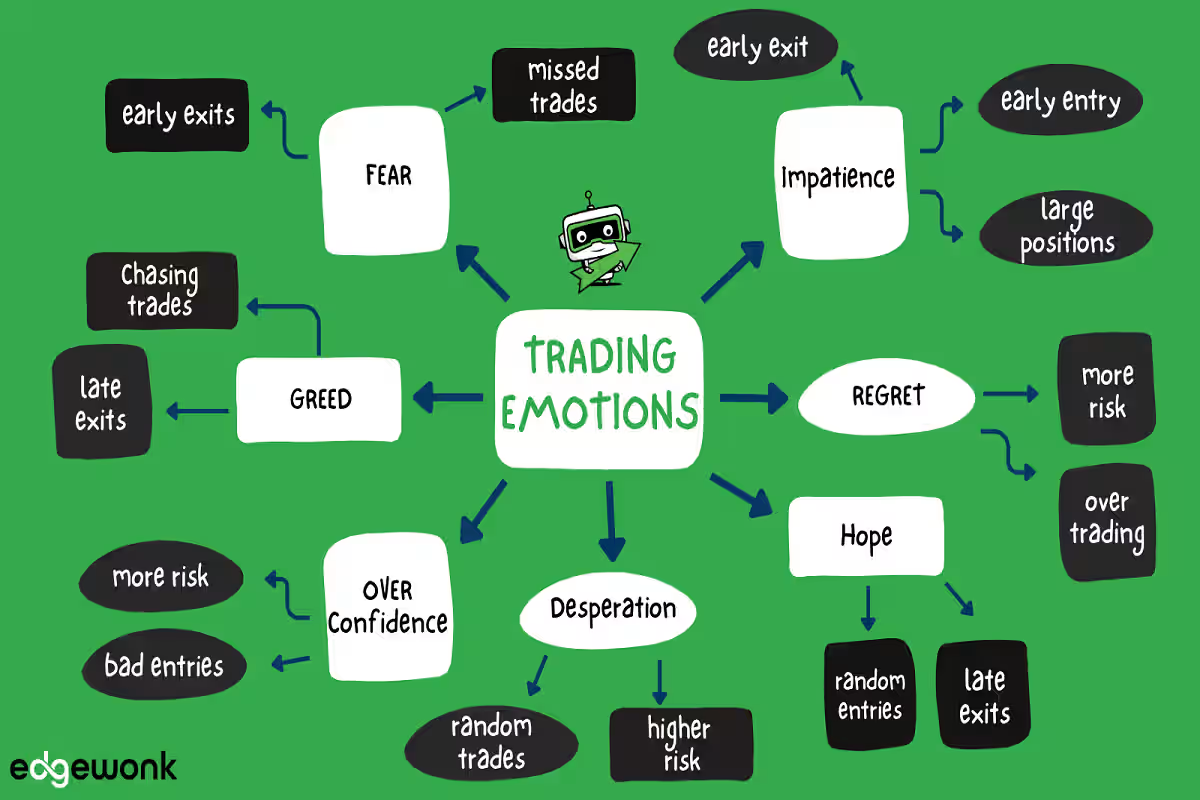
Introduction: The Internal Battlefield of Retail Foreign Exchange Trading
In the vast, trillion-dollar architecture of global foreign exchange markets, technical indicators, moving averages, and order blocks account for only a fraction of trading success. The ultimate determinant of whether an account survives or evaporates lies between the trader's ears. Among the most destructive psychological traps that decimate retail capital accounts are two interconnected emotional malignancies: Fear of Missing Out (FOMO) and Revenge Trading. These behavioral anomalies hijack normal neurological responses, turning disciplined market participants into reactive gamblers chasing erratic price spikes.
Institutional trading desks understand that retail emotional volatility is a primary source of market liquidity. When retail traders panic-buy runaway candles or double down on losing positions to recover capital, they are inadvertently feeding institutional liquidity pools. This masterclass provides a deep-dive behavioral manual to help you recognize, dissect, and permanently rewire your mental execution framework. By understanding the neurochemistry of loss aversion and establishing rigid mechanical protocols, you can transform from an emotional spectator into a systematic institutional operator.
1. The Neurochemistry of FOMO: Why Markets Trigger Impulsive Chasing
FOMO is not merely a lack of willpower; it is a primal neurological response deeply embedded in human evolution. When a retail trader watches a currency pair like the EUR/USD or GBP/JPY rocket upward by 80 pips in a matter of minutes, the brain releases a flood of dopamine—the same neurotransmitter associated with risk-taking and instant gratification. The psychological pain of watching others profit triggers a sense of exclusion, overpowering analytical judgment and prompting the trader to market-buy at the absolute worst possible price.
Rapid price movement simulates a reward loop. Entering a runaway trade gives an immediate chemical rush, blinding the trader to terrible risk-to-reward ratios and overextended chart structures.
FOMO blinds traders to institutional reality. They fail to notice that price is rocketing directly into a daily resistance zone or a major liquidity pool where smart money is looking to offload inventory.
Chasing a moving candle almost always results in buying the top or selling the bottom. The entry lacks structural defense, forcing the trader to use wide, unmanageable stop losses.
Professional desks train themselves to view missed moves as irrelevant. If a setup does not meet strict pre-planned criteria, sitting on the sidelines is classified as a successful trade execution.
Overcoming FOMO requires shifting your self-worth away from individual price swings and anchoring it entirely to adherence to your trading plan.
Psychological State Matrix: Emotional Triggers vs. Systematic Execution
fxone.online behavioral labThe breakdown below compares how emotional impulses distort decision-making versus how institutional frameworks maintain operational consistency.
2. Anatomy of Revenge Trading: The Amygdala Hijack Explained
If FOMO is driven by greed and the fear of exclusion, Revenge Trading is driven by pure rage, wounded ego, and loss aversion. When a trader experiences an unexpected or painful stop-out, the amygdala—the brain's emotional processing center—triggers a fight-or-flight response. Rational prefrontal cortex activity shuts down, replaced by an urgent, burning desire to "make the money back immediately" from the market.
To neutralize revenge trading, institutional desks enforce strict circuit breakers. Here is how the revenge cycle operates and how to break it:
-
Phase 1: The Initial Loss & Ego Injury: A clean setup fails due to sudden market noise or news volatility. Instead of accepting it as a normal business expense, the trader feels personally insulted by the market.
-
Phase 2: Lot Size Escalation: To recover the lost capital quickly, the trader doubles or triples their standard lot size, throwing out their 1% risk management rule entirely.
-
Phase 3: The Death Spiral: The revenge trade goes underwater immediately. Panic sets in, leading to manual closing at terrible prices, followed by immediate counter-trading until the account balance reaches zero.
-
Phase 4: The Institutional Circuit Breaker: Professional traders implement a mandatory "Two-Loss Walk-Away Rule." If two consecutive trades hit stop losses, the trading platform is closed for the remainder of the session.
Recognizing that the market has no personal vendetta against you is the first step toward emotional detachment. The market is simply an auction house matching buyers and sellers; it does not know who you are.
Visual Masterclass: Rewiring Trading Psychology & Overcoming Emotional Traps
Watch this comprehensive analytical breakdown examining how professional traders manage psychological pressure, eliminate emotional decision-making, and build unbreakable execution discipline.
3. Practical Frameworks: Building an Unshakeable Execution Routine
Eliminating FOMO and revenge trading cannot be achieved through positive thinking alone. It requires building rigid, automated operational boundaries that protect you from your own psychological weaknesses during high-stress market sessions.
Institutional desks enforce specific behavioral guardrails to maintain peak performance:
-
Pre-Market Checklists: Define your exact trading pairs, key price levels, and directional bias before the London or New York sessions open. If a setup is not on your pre-planned list, do not touch it.
-
Screen Time Limits: Staring at charts for 8 hours straight breeds over-trading. Professional traders execute their setups, set alerts, and step away from the terminal.
-
Objective Journaling: Document every trade not just by profit and loss, but by psychological state. Rate your emotional discipline from 1 to 5 for every execution to spot recurring behavioral patterns.
When your trading routine becomes mechanical and procedural, emotional impulses like FOMO and anger are starved of the oxygen they need to ruin your account.
Comparative Matrix: Emotional Speculator vs. Institutional Professional
Review the stark differences in behavioral patterns and execution habits between amateur speculators and professional market operators.
| Execution Dimension | Emotional Speculator Approach | Institutional Professional Protocol | Impact on Trading Longevity |
|---|---|---|---|
| Response to Missed Move | Chases runaway price action out of FOMO; buys at extremes | Ignores missed moves; waits for structured pullback or next setup | Avoids buying tops and selling bottoms |
| Reaction to Stop-Loss Hit | Seeks immediate revenge by doubling lot sizes and counter-trading | Accepts loss as normal cost of business; walks away for the day | Prevents catastrophic account drawdowns |
| Daily Routine | Random chart browsing; enters trades out of boredom | Strict pre-market analysis; rules-based execution checklist | Ensures consistency and high expectancy |
During a quarterly behavioral audit conducted by the fxone.online research team, we analyzed the performance of a proprietary trading cohort during a volatile Non-Farm Payrolls (NFP) release. Trader Marcus experienced a painful stop-out when an unexpected employment spike swept his short EUR/USD position. In the grip of an amygdala hijack, Marcus immediately doubled his position size and entered a revenge long trade without waiting for a retest of support. Within 15 minutes, the market reversed sharply, wiping out 40% of his total account equity. Recognizing his psychological breach, Marcus implemented our mandatory two-loss circuit breaker for the rest of the week, allowing his mental state to reset. In contrast, cohort member Sarah experienced the exact same NFP stop-out, logged the loss as a standard 1% risk event, closed her terminal, and walked away. Sarah finished the month profitable, while Marcus spent weeks digging out of his revenge-trading hole. This case study demonstrates that emotional discipline is far more important than prediction accuracy in foreign exchange trading.
4. Long-Term Mastery: Cultivating Amoral Acceptance and Patience
Achieving permanent freedom from FOMO and revenge trading requires a fundamental shift in your relationship with money and uncertainty. Professional traders view trading capital strictly as inventory—akin to a retail store owner's wholesale stock. A loss is not a personal failure or a tragedy; it is simply the cost of acquiring business data.
-
Embracing Randomness in Individual Outcomes: Accept that any single trade can result in a loss, even when your technical setup and fundamental analysis are 100% correct. Profitability is a statistical result over a sample size of 100 trades, not a guarantee on trade number one.
-
Celebrating Boredom: If your trading session feels boring, uneventful, and routine, you are likely executing your plan correctly. Excitement in trading usually correlates directly with excessive risk and emotional instability.
-
Continuous Psychological Auditing: Regularly review your trading journal specifically for emotional triggers. Identify the exact times of day or market conditions where you feel the most urge to FOMO or revenge trade, and build rules to avoid those specific windows.
Mastering your own psychology is the final, most challenging frontier in foreign exchange trading. Once conquered, the markets transform from an emotional rollercoaster into a calm, systematic wealth-generation vehicle.
Frequently Asked Questions
How can I physically stop myself from revenge trading after a loss?
The most effective method is the hard circuit breaker: close your trading platform immediately after hitting your daily maximum loss limit or after two consecutive stop-outs. Physically remove yourself from your desk, go for a walk, or engage in a non-screen activity to allow your amygdala to cool down.
What is the best way to deal with the anxiety of missing a big market move (FOMO)?
Acknowledge that the foreign exchange market operates 24 hours a day, five days a week, and thousands of high-probability setups occur every single month. Missing one move does not mean missing your financial future. Shift your focus to waiting for a structured retracement or the next valid setup on your watchlist.
Summary: Rewiring Your Mindset for Institutional Consistency
Overcoming FOMO and revenge trading is the ultimate test of character for any retail foreign exchange trader. By understanding the neurochemistry behind emotional impulses, implementing strict pre-market routines, and enforcing hard circuit breakers after losses, you can eliminate the self-sabotaging behaviors that destroy most trading accounts. True consistency is not born from predicting every market tick, but from mastering your own internal reactions and executing your trading plan with unwavering discipline.
About the Author: FX Research Team, fxone.online
The FX Research Team at fxone.online comprises institutional market analysts, macroeconomic forecasters, and veteran currency traders dedicated to elevating educational standards in retail foreign exchange. Our curriculum cuts through noise, focusing entirely on fundamental catalysts, risk metrics, and structural price mechanics.